
Shoulder and upper-back care
Shoulder Pain Treatment in Savannah and Pooler
Reach, lift, and sleep on your side again.
The shoulder moves more than almost any other joint, so repetitive work, lifting, sport, and posture irritate it easily. Pain with overhead reach or side-sleeping is often where people notice it first.
Our doctors evaluate and treat this condition every day. Tap Dr. Jared , Dr. Samantha , or Dr. Bradlie , or schedule your $49 evaluation to get started.
- Exam of the shoulder together with the neck and mid back
- Care for joint motion, not only the sore muscle

Start with clarity
Your first visit is a conversation, not a commitment.
Where shoulder pain shows up
A wide-moving joint needs a stable base.
Because the shoulder depends on the neck, ribs, and shoulder blade, we do not treat it as an isolated hinge. Stiffness above or below changes how the joint tracks.
Shoulder complex
Overhead and out to the side
When a simple reach starts to catch
We test how the shoulder, neck, and upper back share the motion, then look for muscle, tendon, or joint drivers.
- Discomfort sleeping on the affected shoulder
- Tightness or stiffness in the joint
- Pain that spreads toward the neck or upper back
- Trouble lifting or reaching overhead
Good to know: posture that rounds the shoulders forward often keeps the irritation going between visits.
Your pattern may involve one — or several.
-
Repetitive reach
Work and sport load the same arc of motion every day.
-
Side sleeping
Night pain is a common reason people finally get it checked.
-
Rounded posture
A forward shoulder changes how the joint sits in the socket.
-
Neck referral
Cervical irritation can feel like a shoulder problem.
Care paced to your nervous system
Our root-cause approach
Mobility with something to hold it.
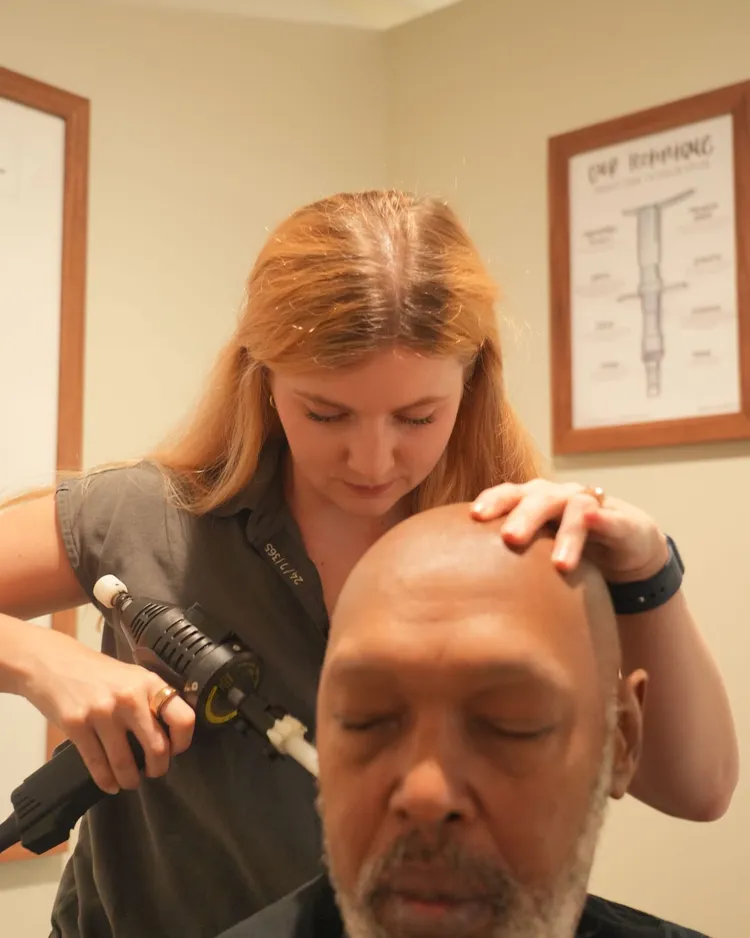
Adjustments to the spine and shoulder complex improve how the joint coordinates. Instrument work keeps it specific. Exercises rebuild the muscles that support the socket.
- The neck and mid back are part of a shoulder exam
- Force is matched to what the joint will tolerate
- Sleep and reaching are the milestones that matter
A clear path forward
What care looks like
-
01
Listen & map
Your history, daily load, and what you want back come first. We do not start with a protocol.
-
02
Evaluate
Motion, orthopedic, and neurologic tests show what is irritated and what can wait.
-
03
Explain
Findings in plain language, including when imaging or another provider is the better next step.
-
04
Restore
Specific care, then movement you can repeat, with milestones you can see.
Built around real life
A plan you can understand — and follow
-
Specific chiropractic care
Adjustments and instrument work aimed at the joints and nerves the exam actually implicated.
-
Movement that makes sense
A short set of exercises tied to how you sit, lift, walk, or sleep — not a generic packet.
-
Progress you can see
We revisit the same measures so you know whether the plan is working.
No pressure. No long contracts. Just a clear next step.
Getting your life back is the outcome that matters.
“I can sleep on that side again without bargaining with the pillow.”

-
Reach
Overhead motion
Checked, not assumed
-
Night
Side sleeping
A common first win
-
Neck
Shared load
Upper back included in the plan
Questions about shoulder pain
Is this a rotator cuff problem or a spine problem?
It can be either, or both. The visit tests the shoulder and the neck so we are not treating a referred pain as if it started in the joint.
Will I need X-rays or an MRI?
Imaging is used only when your history and exam indicate it. Many people start with a hands-on evaluation. X-rays or an MRI are recommended when we need a clearer look at structure or nerve involvement.
Can I be seen during a flare-up?
Yes. A flare-up is a useful time to be seen, because we can compare how you move now with your baseline and adjust the plan. Call the office and we will do our best to see you promptly.
Do you accept insurance?
We offer a complimentary benefits check before care begins. Bring your insurance card, or send it ahead, and we will review coverage, deductibles, and auto-accident benefits when they apply. No services are rendered without your prior knowledge of your benefits.